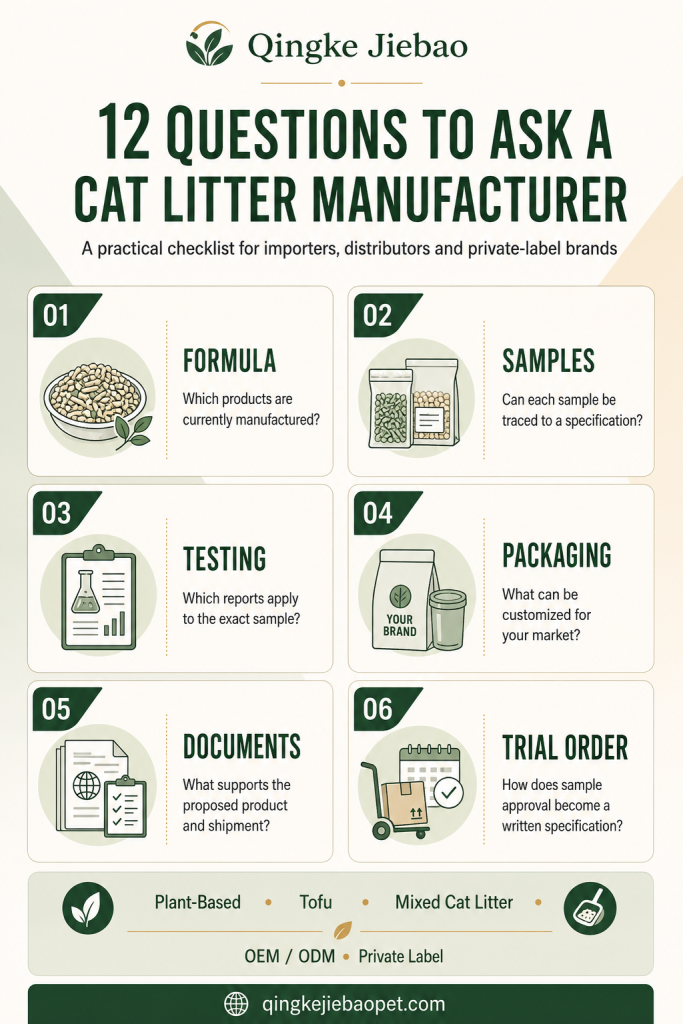
Choosing a private label cat litter manufacturer involves more than comparing a sample and requesting the lowest quotation. Importers, distributors, pet-care brands and e-commerce sellers also need to evaluate formula suitability, packaging options, quality documents, production controls and the process from sample approval to commercial delivery.
This is particularly relevant during major sourcing events. Pet Fair Asia 2026 is scheduled for August 19–23 in Shanghai, with its first three days focused on business visitors and supply-chain activities. The event gives international buyers an opportunity to meet manufacturers, but a short exhibition conversation should be treated as the beginning of supplier qualification—not the final purchasing decision. (Pet Fair Asia official information)
The following 12 questions can help buyers compare a cat litter manufacturer more systematically, whether the first meeting takes place at a trade show, in a factory or online.
Which Cat Litter Formulas Do You Currently Manufacture?
Start by confirming what the factory currently produces rather than relying only on a broad product catalogue.
Depending on your target market, you may be looking for:
- Tofu cat litter
- Plant-fiber cat litter
- Bentonite cat litter
- Cassava cat litter
- Mixed cat litter
- Charcoal or zeolite formulas
- Fine-granule formulas for selected automatic litter boxes
Ask the supplier to distinguish between products in regular production, formulas available for sampling and products that require new development.
A professional cat litter supplier should also ask about your intended sales channel. A formula developed for an independent pet store may require different positioning, packaging and pricing from a product intended for supermarkets, marketplaces or subscription services.
What Can Be Customized Through the OEM Program?
The phrase “full customization” is too vague for a purchasing decision. Ask the manufacturer to list the elements that can actually be changed.
A cat litter OEM project may include customization of:
- Formula
- Granule diameter
- Fragrance
- Color
- Functional ingredients
- Bag weight
- Bag structure
- Vacuum packing
- Printed private-label packaging
- Carton configuration
Qingke Jiebao supports OEM/ODM discussions involving plant-based, tofu and mixed cat litter, including options for formula, fragrance, color, granule size, vacuum packing and private-label packaging. Exact availability should be confirmed against the buyer’s product brief.
Which Formula Fits My Market and Sales Channel?
A supplier should not recommend the same formula to every buyer.
Before requesting a recommendation, provide basic commercial information:
- Target country
- Primary retail channel
- Customer price segment
- Preferred material
- Intended bag size
- Estimated monthly demand
- Private-label requirements
For example, a buyer seeking a lightweight premium product may evaluate tofu or another plant-based formula, while a value-oriented retail program may have different material and landed-cost priorities.
The objective is not to identify one universally “best” cat litter. It is to find a commercially suitable product for a defined market position.
Can You Provide Identified Samples and Specifications?
Each sample should be connected to a formula name, model or specification. Avoid accepting unmarked bags that cannot later be matched to a quotation or test report.
Ask the private label cat litter manufacturer to provide:
- Sample name or model
- Material or formula description
- Granule specification
- Fragrance
- Sample production date or batch reference, when available
- Recommended storage conditions
- Relevant product specification sheet
This makes subsequent cat litter sample evaluation more traceable.
How Should Samples from Different Suppliers Be Compared?
Samples should be tested under the same internal method.
Buyers can develop a simple comparison sheet covering:
- Sample weight
- Liquid quantity
- Absorption time
- Clump formation
- Clump handling
- Visible loose powder
- Tracking observation
- Odor-control evaluation method
- Storage condition
- Packaging condition
The purpose is not to reproduce a laboratory test. It is to prevent one sample from being tested under more favorable conditions than another.
Record the formula and sample identity alongside every result. Photos and short videos can help different members of the buying team review the same observations.
Which Test Reports Apply to the Exact Sample?
Do not assume that one report covers every product made by the factory.
Check the following information:
- Laboratory name
- Report number
- Product or sample name
- Model
- Testing dates
- Test methods
- Reported results
- Accreditation limitations
- Whether the commercial sample matches the tested sample
For example, Qingke Jiebao holds CTI report A2240796224101001C for the tested 1.5A plant original/unscented cat litter sample. In that report, the sample recorded a powder-content result of 0.28% and a water-absorption multiple of 3.31.
These results apply only to the tested sample. They should not be presented as a regulatory approval, a whole-range guarantee or evidence that every production batch will produce identical results.
This sample-specific approach is more credible than unsupported claims such as “zero dust” or “completely safe.”
What Is Checked During Routine Production?
A third-party test report and routine factory quality control are not the same thing.
Ask which properties the manufacturer checks during:
- Raw-material receiving
- Formula preparation
- Granulation
- Drying
- Screening
- Packing
- Finished-product inspection
Depending on the product, buyers may discuss granule dimensions, moisture, package sealing, weight control and other agreed specification points.
The final trial-order specification should clearly state which characteristics are acceptance requirements and how they will be evaluated.
Can You Support Private-Label Packaging?
Packaging must support both transportation and retail presentation.
Ask about:
- Available bag structures
- Vacuum-packing options
- Printing requirements
- Artwork dimensions
- Number of colors
- Carton options
- Pallet configuration
- Barcode placement
- Retail-language requirements
When comparing quotations, confirm whether the price includes a plain bag, sticker label, printed bag, carton or another configuration. Two prices are not comparable if they refer to different packaging.
A buyer seeking custom cat litter packaging should also confirm who reviews the destination-market label. The manufacturer can provide product information, but the importer or brand owner should verify applicable labeling and market-access requirements.
Is the Product Suitable for Automatic Litter Boxes?
Avoid universal compatibility claims.
If the product will be marketed for automatic litter boxes, provide the manufacturer with the target machine model or technical requirements. Relevant factors may include granule size, clump behavior, screening design and the machine manufacturer’s instructions.
Qingke Jiebao offers fine-granule mixed-formula options intended for selected automatic litter-box applications. Compatibility should still be confirmed through model-specific sample testing.
Do not publish “works with every automatic litter box” unless this has been independently established for every named model—which is rarely realistic.
Which Documents Can Be Provided for the Proposed Product?
The required documentation may vary by formula, destination, importer and transport method.
Possible buyer-file documents include:
- Product specification
- Ingredient or composition information
- Safety data documentation, when applicable
- Sample-specific test reports
- Packaging information
- Transport identification documents
- Commercial invoice and packing-list information
Ask which documents apply to the exact commercial product and whether they are current.
An MSDS or laboratory report should not automatically be described as FDA approval, EPA approval, CE certification, REACH compliance or universal import authorization.
What Is Included in the Commercial Quotation?
A useful quotation should identify the assumptions behind the price.
Request clarification of:
- Formula
- Granule specification
- Fragrance
- Bag weight
- Packaging type
- Order quantity
- Incoterm
- Port or destination
- Artwork status
- Quotation validity
- Production schedule
- Sample and packaging approval requirements
MOQ, price, lead time and loading quantity should be confirmed for the specific project. Avoid applying an indicative trade-show quotation to a later order with a different formula or packaging format.
What Happens After Sample Approval?
Before selecting a wholesale cat litter supplier, define the path from sample to trial order.
A practical process may include:
- Buyer submits an RFQ
- Supplier recommends a formula
- Identified samples are prepared
- Buyer completes sample evaluation
- Formula and packaging are confirmed
- A written trial-order specification is approved
- Production and inspection requirements are agreed
- Shipping documents are reviewed
- Arrival condition is evaluated
- Feedback is recorded before a repeat order
The approved specification should include the formula or model, granule size, fragrance, packaging structure, artwork version and agreed inspection criteria.
From Supplier Meeting to Qualified OEM Partner
The best private label cat litter manufacturer is not necessarily the company offering the lowest verbal price or the longest list of marketing claims.
A more reliable supplier-selection process focuses on four questions:
- Can the supplier provide a product that fits your market?
- Can samples and documents be traced to an exact specification?
- Can packaging and private-label requirements be clearly defined?
- Can both parties turn sample approval into a documented trial order?
Qingke Jiebao manufactures plant-based, tofu and mixed cat litter and supports OEM/ODM and private-label discussions. Buyers can contact the team with their country, company, target formula, estimated monthly quantity and packaging requirements.
This information allows us to recommend a more relevant starting formula and prepare a focused sample discussion instead of sending a general price list.
Request an OEM Cat Litter Discussion
Tell Qingke Jiebao about your target market and product plan:
- Country
- Company
- Target formula
- Preferred granule size
- Packaging requirement
- Estimated monthly quantity
- Private label needed: Yes or No